
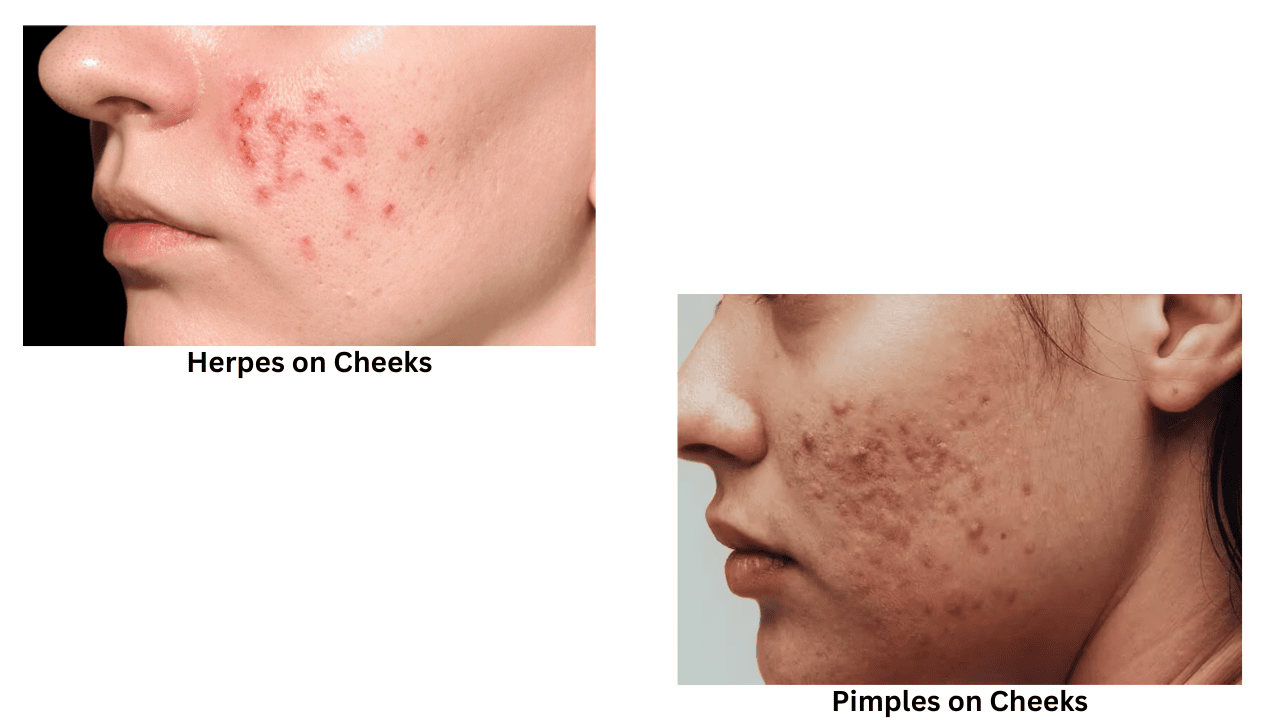
Many people live with herpes without even realizing it. Why? Because in its earliest stages, the signs of herpes often look like harmless everyday skin problems just like a pimple, an ingrown hair, or even a patch of chapped skin. It’s easy to ignore, but ignoring these subtle symptoms means the infection can go unnoticed for months or even years.
Herpes isn’t rare, in fact, it’s one of the most common viral infections worldwide. HSV-1 (oral herpes) usually shows up as cold sores around the mouth, while HSV-2 (genital herpes) tends to affect the genital area. Together, they affect millions of people globally, many of whom don’t know they have it.
The goal of this blog isn’t to help you look closely at your own symptoms and compare them with typical herpes signs, no matter where they may appear on the body. Being alert and informed is the first step toward protecting your health — and the health of your partners.
Why People Miss It: Symptoms Mimic Everyday Skin Problems
One of the biggest reasons herpes goes unnoticed is that its symptoms don’t always look alarming. Instead, they often resemble common, everyday skin issues that most of us wouldn’t think twice about.
- Acne or pimples
- Ingrown hairs or razor burn
- Mouth ulcers or canker sores
- Simple skin rashes
Herpes can hide behind these above mentioned common disguises, many people don’t realize they’re carrying the virus until symptoms become more severe or recurring. This overlap makes testing the only reliable way to know for sure.
Key Symptoms of Herpes to Watch For to differentiate them from the common conditions.
In case of Herpes people notice a tingling or burning sensation even before anything even appears on the skin — thus usually is not given by acne or pimples. Then, instead of a single blemish, herpes often develops as a group of tiny fluid-filled blisters clustered closely together.
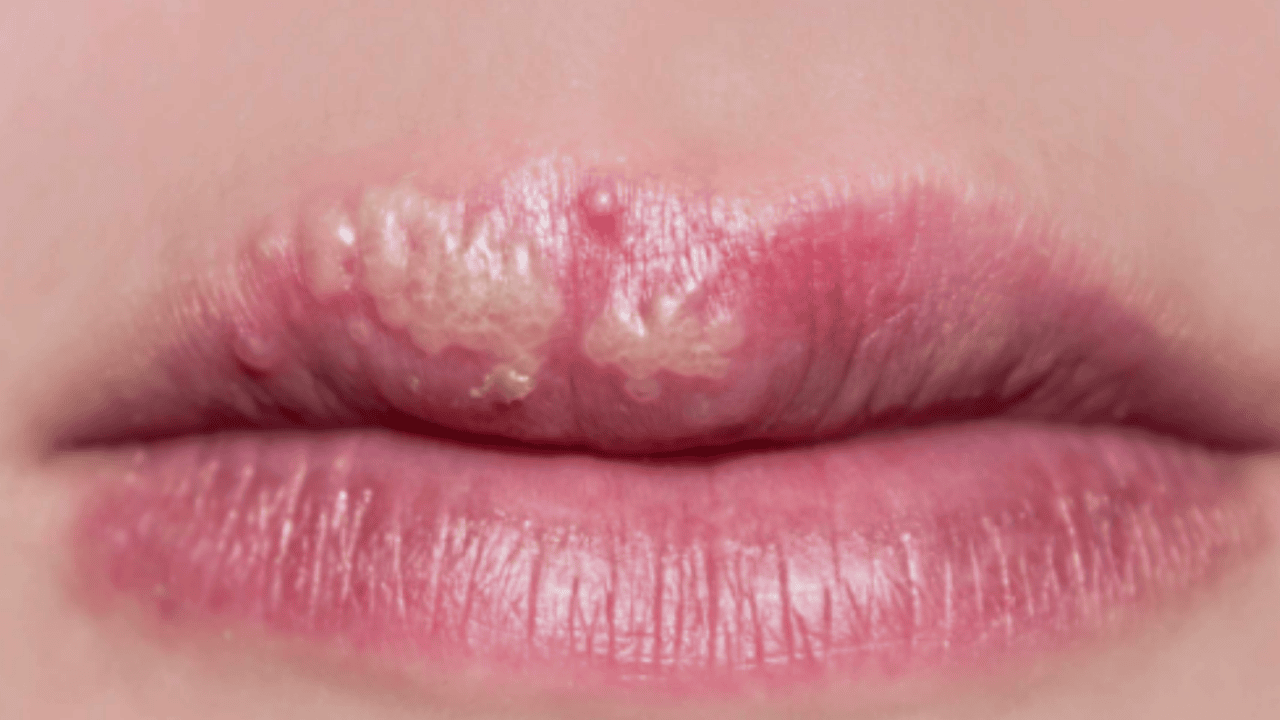
These blisters can be painful, and when they break, they leave shallow sores that take days to heal. Unlike a one time rash or irritation, herpes tends to return in the same area, cycling through flare-ups and quiet periods.
Even oral herpes, which shows up as cold sores, can be mistaken for chapped lips or mouth ulcers,(which will be discussed later in this blog) but the recurrence and pattern of blistering usually reveal the difference. Recognizing these subtle but repeating patterns is the first step in telling herpes apart from other everyday skin conditions.
When most people say “herpes,” they’re usually talking about HSV-1 or HSV-2, two very common members of the herpes virus family. But herpes isn’t a single virus and here’s what you really need to know in a straightforward way:
- HSV-1: This is the type that usually shows up around the mouth as cold sores. But it doesn’t only stay there, but HSV-1 can also spread to the genitals through oral sex.
- HSV-2: This one is typically genital herpes. It’s extremely common and obviously mostly spread through sexual contact.
There are also other herpes-family viruses that cause very different illnesses: Varicella-Zoster Virus, Epstein-Barr Virus (EBV), Cytomegalovirus (CMV)
In this blog we will discuss and help you recognize herpes which can be mistaken with the other similar looking diseases
Oral Herpes (HSV-1): Spotting Cold Sores(Herpes) vs. Lip Pimples
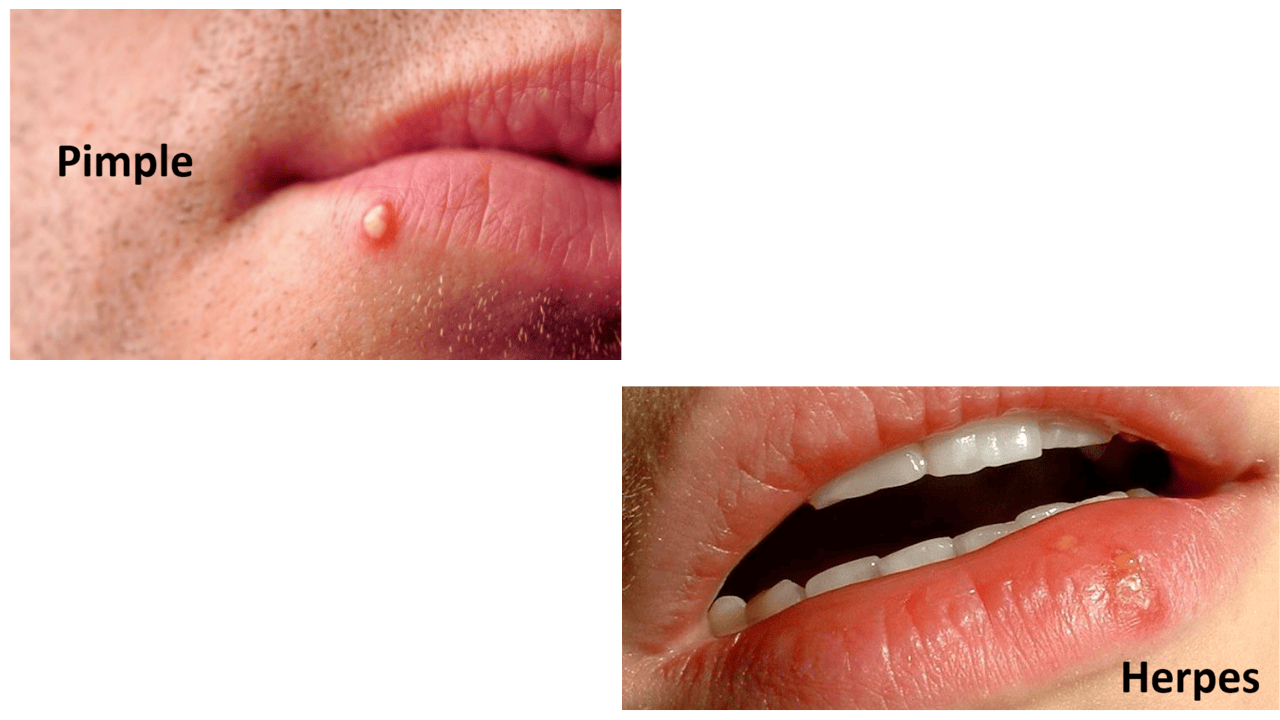
When you notice bumps around your lips, it’s easy to wonder whether you’re dealing with herpes or just a regular pimple. While both can appear on or near your lips, they have distinct characteristics that make them quite different once you know what to look for.
What herpes cold sores actually look like?: Oral herpes typically starts as small, fluid-filled blisters that cluster together in groups. These blisters have a clear or slightly cloudy liquid inside and sit on a red, inflamed base. After 2-3 days, they burst open, leaving shallow, painful ulcers that then form a yellowish or honey-colored crust. The entire outbreak usually follows this exact progression: tingling → blisters → bursting → crusting → healing.
Also, the Herpes ulcers on lips may appear close to each other like forming a cluster which is a peculiar symptom of herpes.
How pimples on lips are different?: A lip pimple is usually a single, raised bump with a white or yellow center (pus-filled). It’s typically larger than individual herpes blisters, appears alone rather than in clusters, and has a firmer feel. Pimples don’t go through the blister-to-crust cycle that herpes does.
Key visual differences you can see in photo above: Herpes appears as multiple tiny blisters grouped together, often covering a larger area of the lip. Pimples show up as one isolated bump. Herpes blisters look more fragile and watery, while pimples appear more solid and raised.
Symptoms that aren’t visible but help tell them apart: Herpes almost always starts with that distinctive tingling or burning sensation 1-2 days before blisters appear. Pimples might feel tender when touched, but they don’t have that “electric” tingling warning sign. Herpes outbreaks also tend to recur in the same spot, while pimples pop up randomly.
Oral Herpes (HSV-1) vs Mouth Ulcer on Gums and Roof of the Mouth
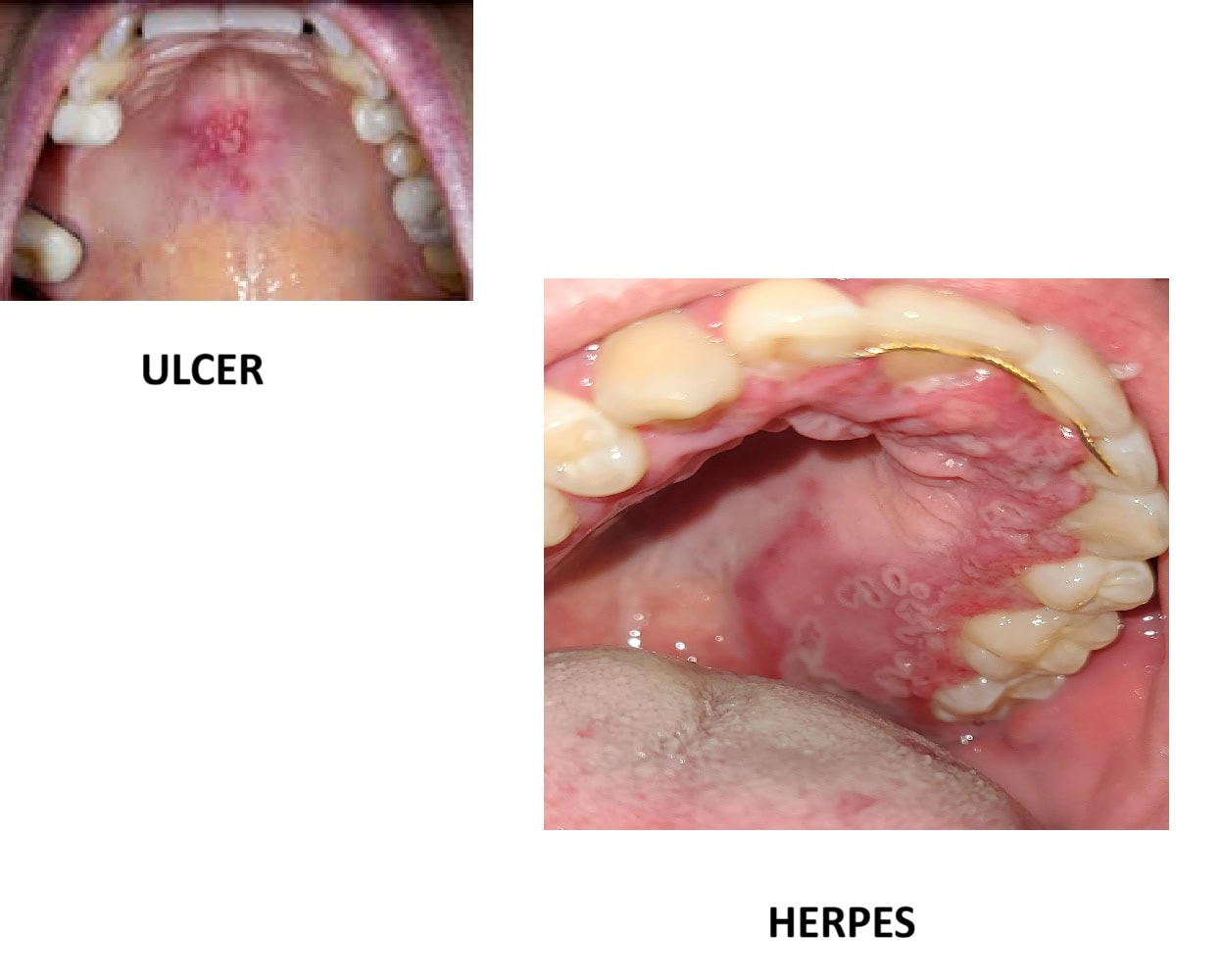
Sometimes herpes doesn’t just show up on the lips, it can appear inside your mouth, especially on the gums or the roof of the mouth. That’s where it often gets confusing, because there are many other mouth problems that can look or feel similar.
How herpes looks and feels inside the mouth: When HSV-1 affects the gums or hard palate, it usually starts with pain, burning or tingling before any bumps appear. Soon after, you’ll see small, grouped fluid-filled blisters on the gums or roof of the mouth. These tiny blisters can burst quickly, leaving behind shallow, red ulcers that are quite painful. Over time, they may get covered with a yellowish film or crust before healing. Eating or drinking hot/spicy foods during this time often feels uncomfortable.
Mouth ulcers, medically known as aphthous ulcers or aphthous stomatitis (commonly called canker sores), can appear on the gums and roof of the mouth and may initially seem similar to oral herpes, but there are key differences.
How mouth ulcers look and feel: Unlike herpes, canker sores typically start as a small, round or oval red spot that quickly develops into a shallow ulcer with a white or yellowish-gray center and a distinct red border or halo around the edges. They usually appear as single lesions or just a few scattered ulcers, rather than in tight clusters like herpes blisters.
Canker sores do not begin as fluid-filled blisters—they develop directly as ulcers. You’ll feel pain or a burning sensation at the site, which worsens when eating acidic, spicy, or salty foods. The pain is typically most intense in the first few days and gradually decreases as healing progresses.
Key differences from herpes: Aphthous ulcers are not caused by a virus and are not contagious. They don’t form grouped blisters that burst; instead, they appear directly as open sores. Common triggers include minor mouth injuries (from dental work, aggressive brushing, or accidentally biting the inside of your mouth), stress, hormonal changes, nutritional deficiencies (particularly B12, folate, or iron), or certain foods. Most canker sores heal on their own within 1-2 weeks without leaving scars.
Herpes on the Face & Skin
While both herpes and pimples can appear as red bumps on the cheeks, there are distinct differences that can be the differentiating factor. Herpes on the face typically can appear like the clusters of small, fluid-filled blisters grouped closely together on a red, inflamed base. These blisters are uniform in size, appear suddenly, and are usually followed by tingling, burning, or itching sensations in the very spot. The blisters often ooze clear fluid before drying and crusting over with a yellowish or honey-colored scab. Facial herpes tends to recur in the exact same location and follows a predictable pattern:
tingling → blisters → weeping → crusting → healing over 7-14 days.
Pimples (acne), on the other hand, develop individually or in scattered patterns across the face, not necessarily in clusters. They form as whiteheads, blackheads, or red inflammatory bumps with a single point of inflammation, and they develop gradually over days rather than appearing suddenly.
Herpes cause the pre-eruption tingling that herpes does, and they don’t go through the blister-weeping-crusting cycle. Acne also varies in appearance across the face. You’ll see different stages (some healing, some new) at the same time, whereas a herpes outbreak appears all at once and progresses through stages together. If you notice grouped blisters that weep and crust, especially if they return to the same spot, it’s more likely to be herpes and warrants a consultation with a healthcare provider for proper diagnosis and treatment.
Key Symptoms of Genital Herpes to Watch For to differentiate them from the common conditions.
Identifying herpes can be challenging, as many of its symptoms resemble those of more common conditions such as genital warts, canker sores, acne, or irritation from shaving. That said, herpes follows a distinct pattern with specific characteristics that become recognizable once you understand what to look for. Being aware of these key symptoms is essential for early detection and seeking appropriate treatment when needed.
Common Conditions That Can Be Mistaken for Genital Herpes
Distinguishing genital herpes from other conditions is very difficult. As several infection and skin issues mimic Herpes. Many people understandably worry that any unusual bump or sore in the genital area or discharge might be herpes, but correct identification requires understanding the subtle differences.
Chancroid: A Bacterial Infection That Mimics Genital Herpes
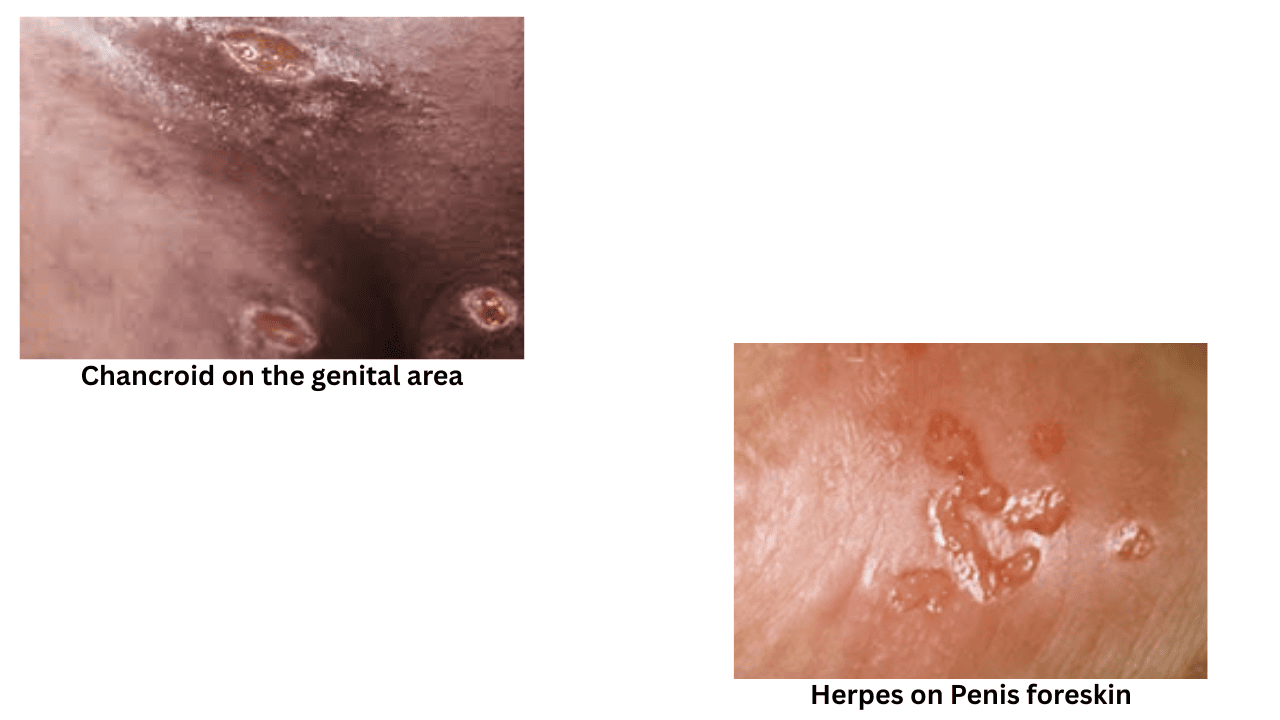
Chancroid is a sexually transmitted infection caused by the bacterium Haemophilus ducreyi. It produces painful genital ulcers that can closely resemble a severe herpes outbreak, making it easy to confuse the two conditions. Both infections cause painful sores in the genital, perianal, or perineal regions, and both can result in multiple lesions accompanied by enlarged, tender lymph nodes in the groin.
However, there are important differences. Chancroid ulcers tend to be deeper with ragged, undermined edges and a pus-filled base, while herpes typically begins as small, grouped blisters that burst to form shallower ulcers with more regular borders. That said, visual examination alone is often insufficient for accurate diagnosis. Laboratory testing—including HSV PCR testing and specific tests for H. ducreyi—is necessary to definitively distinguish between these two infections.
Genital Warts: HPV-Related Growths vs Herpes
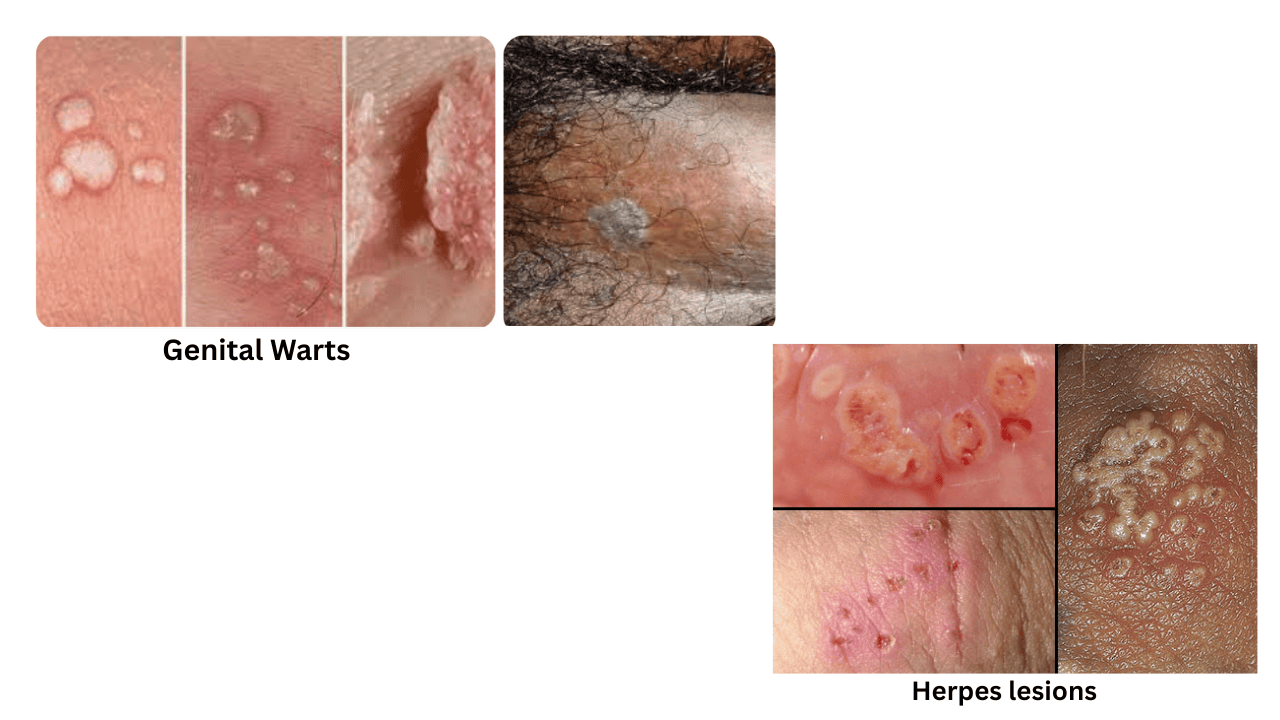
Genital warts, caused by certain strains of human papillomavirus (most commonly HPV types 6 and 11), are another frequent source of confusion. When these warts first appear as small, flesh-colored bumps, particularly if several are clustered together, people may mistakenly assume they have herpes—especially if there’s any mild irritation or burning.
Despite initial similarities, genital warts have distinct characteristics. They typically develop a papillary or cauliflower-like appearance and are usually painless or only mildly itchy, lacking the sharp pain and tingling prodrome that often precedes a herpes outbreak. Additionally, herpes lesions progress from blisters to open sores to crusts over the course of days, whereas genital warts are persistent growths that slowly enlarge over time without ulcerating. When the clinical picture is unclear, dermatoscopic examination or biopsy can help differentiate HPV-related lesions from herpes.
Ingrown Hairs and Shaving-Related Bumps vs Herpes
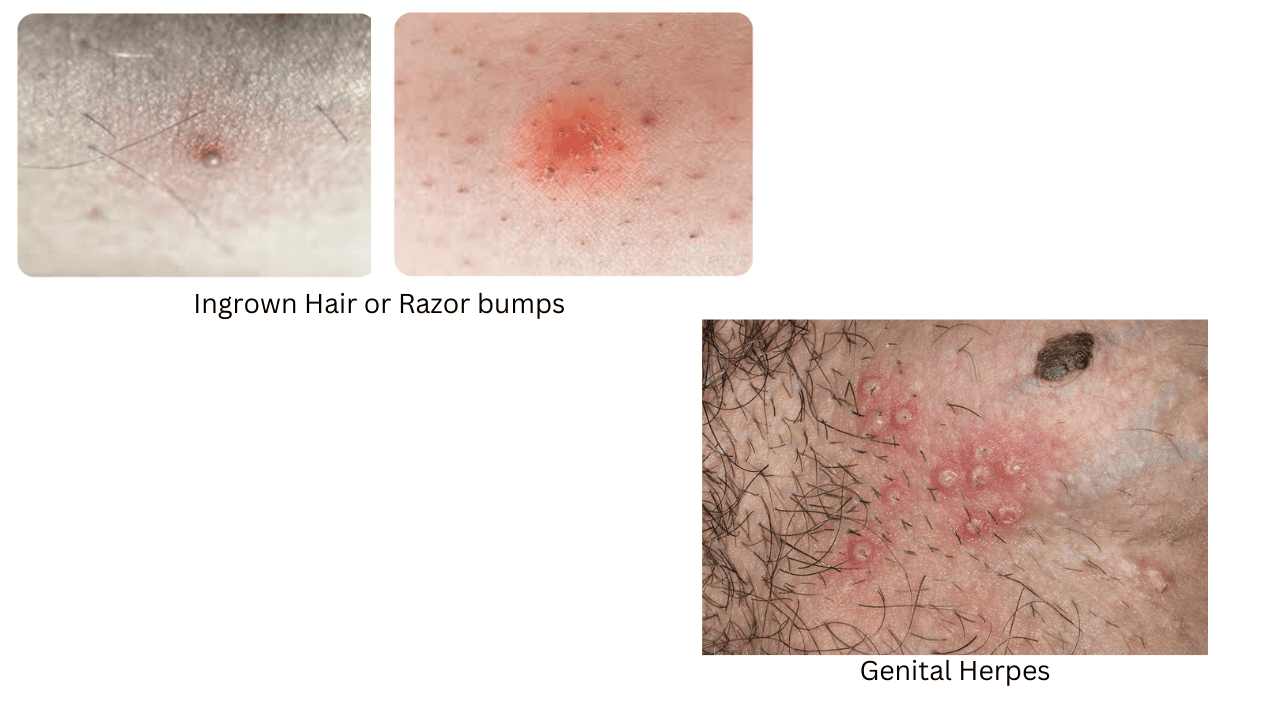
Ingrown hairs and shaving-related irritation (pseudofolliculitis) in the pubic region are among the most common causes of misdiagnosis or self-diagnosis of genital herpes. After waxing, shaving, or other hair removal, small, tender, red bumps or pustules can develop along hair-bearing areas—including the pubic mound, outer labia, scrotum, or inner thighs.
These bumps can resemble individual herpes lesions, and understandable anxiety about sexually transmitted infections often leads people to assume the worst. However, several features help distinguish shaving bumps from herpes. These lesions are clearly associated with hair follicles and often have a visible curled or trapped hair within them. They tend to appear scattered or isolated rather than forming the tight clusters characteristic of herpes. Additionally, there’s typically no preceding tingling or burning sensation, and the lesions don’t follow the classic herpes progression from blister to ulcer to crust. A history of recent hair removal, tight clothing, or friction, combined with examination showing follicular involvement, usually points toward pseudofolliculitis rather than herpes.
Yeast Infections: Fungal Overgrowth vs Herpes
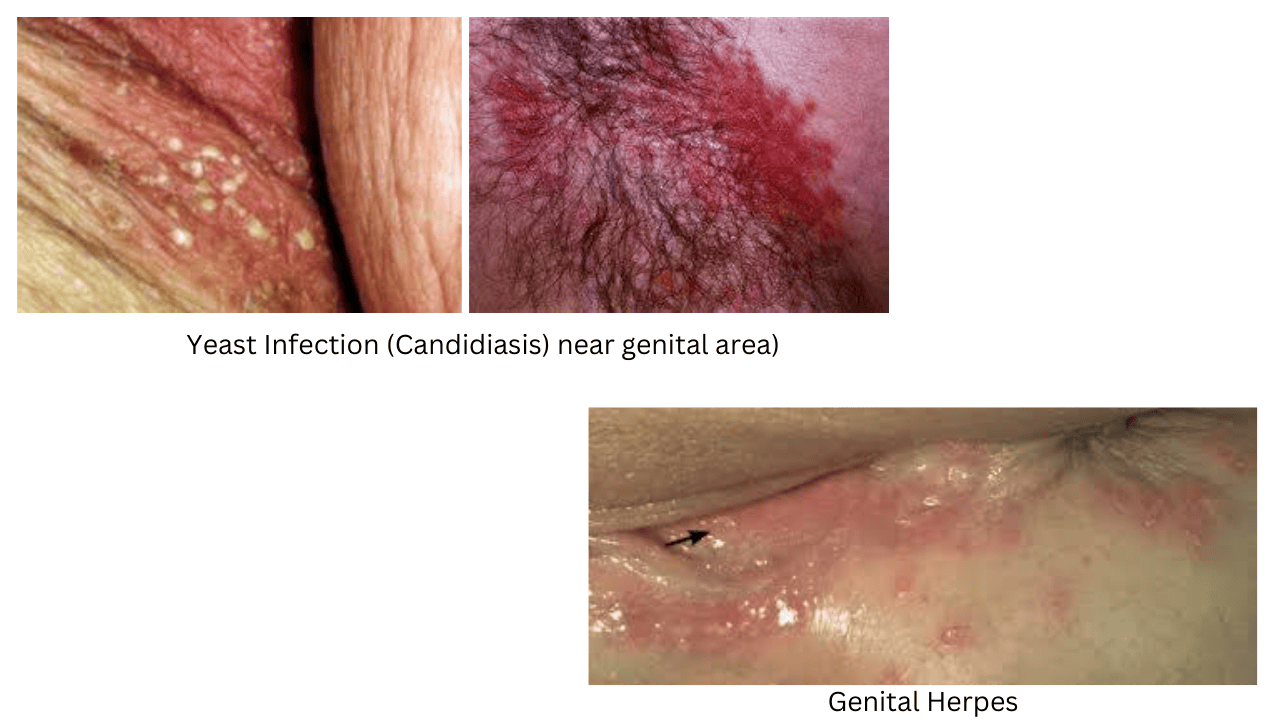
Genital yeast infections (candidiasis) can also be confused with herpes, particularly in cases where herpes presents atypically or blisters are not expected to appear. Yeast infections typically cause severe itching, redness, and a burning sensation. Scratching & moisture-related breakdown of the skin can produce small erosions, cracks, or scattered bumps that visually resemble healing herpes lesions.
Both conditions can cause burning or stinging in the genital area, redness, discomfort during intercourse or urination, and understandable fear that symptoms indicate an STI. However, yeast infections usually present with distinctive features: thick, white, cottage cheese-like vaginal discharge in women, moist red patches with small surrounding pustules, and a distribution favoring skin folds. Herpes classically shows grouped blisters on a red base that progress to open sores and then crusting, often accompanied by systemic symptoms like fever or body aches during the first outbreak. Laboratory tests—including microscopy, yeast culture, and STD testing near you who provide definitive answers when visual examination alone is inconclusive.
Besides the above mentioned symptoms, herpes is also confusing as it is accompanied by itching, feverish, discharge flowing through genital’s while many people having no symptoms at all, leading to misdiagnosis or unawareness. Key confusing factors also include mild initial outbreaks, symptoms like painful urination or vaginal discharge, and systemic signs like headaches or swollen lymph nodes, easily mistaken for other common.
The Importance of Professional Diagnosis
The key takeaway is this: visual inspection alone is often unreliable when it comes to genital lesions. Chancroid, folliculitis, yeast infections, ingrown hairs, and genital warts can all be mistaken for herpes—and vice versa. If you notice any unusual sores, bumps, or ulcers in the genital area, it’s important to seek medical evaluation.
The bottom line? Visual inspection alone is often unreliable when it comes to identifying herpes. If you notice any unusual sores, bumps, blisters, or ulcers—whether on your mouth, face, or genital area—don’t wait or guess. The only way to know for certain is through proper testing. An accurate diagnosis ensures you receive the right treatment, can protect your partners, and gain peace of mind. Get tested for herpes today and take control of your sexual health with confidence.


“
References
Herpes: Reference Annexure 5
https://www.ncbi.nlm.nih.gov/pmc/articles/PMC2099568/
https://www.who.int/news-room/fact-sheets/detail/herpes-simplex-virus